
Call(281) 379-3467 Call(281) 379-3467

Competitive Swim Skills & Swim Team Readiness

An adult student receiving personalized feedback from a swim instructor during a private session in a heated indoor pool.

Helping Your Child Prepare for Competitive Swimming

Welcome to our final post in our ‘Welcome to FINS Intro to Competitive Swim ’ series. We hope that you have found these emails informative and helpful. Don’t forget, we love your feedback! Our goal at FINS is to keep parents informed about what their child is learning in class and to provide various helpful tips at FINS. As always, ALL FINS team members are happy to help answer questions and address concerns as you have them.

Consistency is the key to mastery. The more consistently they practice the skills they are learning in class, the quicker they will master them. We always recommend extra swim time, especially if your child has access to a pool. Please remember, even though they are becoming stronger swimmers, your child still must be under adult supervision while at the pool or other body of water. Safety is our top priority at FINS. We are teaching skills that help your child to become a safer swimmer, but swim lessons never replace the need for adult supervision. Lessons are just another layer in drowning prevention.

When Is Your Child Ready to Join a Swim Team?

As your child progresses through our Intro to Competitive Swim levels, we hope they love swimming as much as we do! If your child has expressed interest in joining a swim team, we think it is a great idea! We highly recommend starting with your neighborhood summer league team. Summer league teams practice from late April through mid-June. Practices will be held at your neighborhood pool and there will be 6 weekend swim meets (and a few more if your child qualifies). Joining the swim team in the neighborhood is a wonderful social opportunity for you and your child too. Many friends from school will be on the team with them! If your neighborhood does not have a swim team, ask a schoolmate or 2 where they swim. There are several teams in the area with open enrollment, so they can swim with their friends on a local area team. If they love summer league, your child can look into swimming year-round on a USA swim team. The Houston area is blessed with a large number of great USA Swim Teams. We recommend visiting a few during their tryout weeks and finding one that is the best fit for your family.

Swim Training Tools & Skills for Kids

An adult student receiving personalized feedback from a swim instructor during a private session in a heated indoor pool.

Essential Equipment for Developing Swim Skills

We hope you are having a FINStastic day! You have been in the Intro to Competitive Swim lessons for weeks now and we hope your child is having a blast. We get questions all the time about equipment and tools needed for swim lessons. Today we are here to answer all of your questions about goggles, flippers and swim caps, oh my!

Goggles:

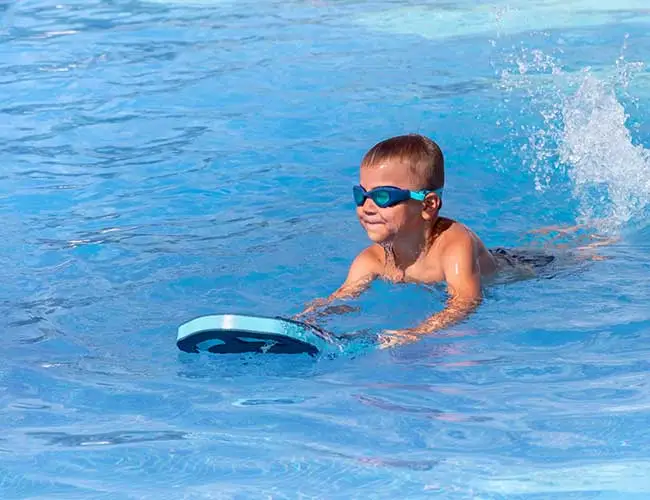
At this stage of swim lessons, most, if not all students will want to use goggles. Prolonged water exposure, whether in a pool or natural body of water, can irritate the eyes. Students in these levels will be swimming longer distances, so most will prefer goggles. The ability to keep their eyes open underwater and not have to worry about splashes coming their way will also free up a lot of distractions for your child. If your child does prefer to wear goggles, we do ask that they have their own pair. FINS has a limited number of pairs available to borrow for the occasional use by children who forget to bring their own. Having their own good pair of goggles helps the instructor to focus the entire class time on learning to swim, not adjusting goggle straps every time a different child wears them. Your child will also be familiarized with their own pair and will be able to keep the straps set to fit them the way they prefer. How do we define a “good pair” of goggles? First and foremost is comfort. The child must like the way they feel. Secondly, you must make sure the part around the eye seals tightly on the face. If the goggles are too big (or too small) water will constantly leak in making the goggles essentially useless. FINS sells goggles we LOVE and work well for many swimmers. In addition, there are a few local swim shops who sell other brands if you would like to explore further. Buying goggles at a big box store may not be the best plan. We tend to notice more leaking and quicker breaking of those goggles. A good pair purchased a FINS or a local swim shop will only cost a few more dollars, but will be worth it’s weight in gold!

Swim Caps:

We get a lot of questions about swim caps. While yes, it is true that all professional swimmers use swim caps, FINS does not require them. At this point it is a personal preference. Keep in mind that if your child does have long hair, it will need to be either tied back or in a swim cap during lessons.This helps avoid hair getting into the eyes,over the face and/or tangled in arms while practicing their swimming skills. FYI, swim caps will not keep the hair completely dry, or all water out of the ears. While the hair will not get quite as wet wearing a swim cap, it does not completely protect the hair from getting wet. Swim caps are not designed for keeping water out of a swimmer’s ears either.

Flippers/fins:

We normally refer to them as fins, but since our name is FINS we also call them flippers to avoid confusion. They are one and the same! Students will begin using flippers/fins in our Bronze FINS level and each student will need to bring their own pair to each lesson. While we do have a few pairs for students to borrow if they forget their own, we do not have enough for every student. Flippers/fins in these levels are used to help students elongate their kicks, encourage proper body positioning, balance, swim endurance and to build foot, ankle and leg strength. The use of fins/flippers activates different muscles which will help build stronger swimmers! Not to mention that the kids find them very fun as they swim faster in them!

Be on the lookout next week for our final email in this series. We will talk about ways you can help further advance your child’s swim skills by practicing at home, and about the available options for swim team if your child has expressed interest!

Competitive Swim Parent Portal

An adult student receiving personalized feedback from a swim instructor during a private session in a heated indoor pool.

Track Your Child’s Competitive Swim Progress Online

We hope this email finds you well and that our weekly emails are answering all of your questions while also teaching you about things you didn’t even know to ask about! Our goal is to have every parent at FINS feeling very informed about what their child is learning, why it is important and how they can expect to see everything play out during swim lessons.

Today’s blog post is going to divert from what is happening in the classes to show you how you can use FINS Parent Portal online to check on your child’s skill progression, make updates to your account, email your child’s instructor, see class openings and more!

Instead of writing a long post about all of the things you can do, here is a 2 minute YouTube video all about the FINS Parent Portal.

If you attempt to log in and do not know which email address we have on file, please give us a call or stop by the front desk and we are happy to help! Additionally, we can always do a quick password reset for you if needed! Tablets are available at our facility if you would like to try the portal while you are here, we’re happy to help!

Thanks for watching, reading, and learning! We hope each week you find the provided information helpful and that you are learning something new. Be on the lookout for an email next week where we talk about tools & supplies needed in swim class and what each is used for.

Advanced Competitive Swim Skills for Kids

An adult student receiving personalized feedback from a swim instructor during a private session in a heated indoor pool.

How Swim Skills Progress Through Each Competitive Level

Congratulations! You’re rolling right along in our Intro to Competitive Swim program. We hope swimming is an activity that they (and you) look forward to each week. Each lesson they are not only are they mastering new skills toward advanced water safety, but they are also learning advanced swim skills. The cool thing about swim lessons is that it is an activity they can enjoy for the rest of their life. As your child grows, knowledge of water safety and swim skills can be used at the neighborhood pool, on family vacations, birthday pool parties or even to get involved in the sport of swimming by joining a swim team (which we will talk about in a few weeks)!

This week, we are going to discuss swim progression and learn just how far (distance-wise) your child will be able to swim by the time they complete our Intro to Competitive Swim levels.

Dolphin FINS:

When students are ready to exit the Dolphin FINS level, they will have mastered swimming the breaststroke a full length of the pool. In addition to mastering the breaststroke, they will continue to build strength and endurance in freestyle and backstroke.

Shark FINS:

When students are ready to exit the Shark FINS level, they will have mastered swimming the butterfly a full length of the pool. In addition to mastering the butterfly, they will continue to build strength and endurance in freestyle, backstroke, and breaststroke.

Fast FINS:

Students enrolled in our Fast FINS class will spend the majority of class time on swim endurance. Students in our Fast FINS classes will be able to swim 2 full lengths of the pool in freestyle and backstroke without rest. In addition, they will continue to build strength and endurance during full laps of breaststroke and butterfly.

Thanks for reading and learning! We hope each week you find the provided information helpful and that you are learning something new. Be on the lookout for an email next week where we will tell you all about the online FINS Parent Portal and all the cool things you can do, like check on your child’s skill progression, make updates to your account, and more!

Welcome to the FINS Intro to Competitive Swim Program

An adult student receiving personalized feedback from a swim instructor during a private session in a heated indoor pool.

What to Expect From the Intro to Competitive Swim Program

We are thrilled that you have chosen FINS as your swim school! FINS is a locally owned, family-run business with a big passion for teaching water safety and developing a love for swimming. By giving the gift of swim lessons to your child, you have taken an amazing step forward in the fight against the drowning statistics. Did you know that drowning is the leading cause of accidental death in children ages 1-4, and the 2nd leading cause of children ages 5-14? Drowning is preventable. Additionally, swimming is a great team sport for your child that helps teach discipline, social skills and keeps them active!

FINS has been around for over 20 years. Throughout that time, we have taught thousands of children (and adults) to learn to swim. Many of these students have gone on to be quite successful with various swim teams. Our goals remain the same while our methods vary over time since we are constantly finding ways to advance our techniques while providing a safe and fun environment for you and your child.

Read on and learn a bit more about what you and your child have to look forward to while swimming with FINS!

SAFETY-ADVANCED SWIM STROKES-SWIM ENDURANCE-FUN!

These are the foundational elements of our unique Intro to Competitive Swim program. This program includes levels: Dolphin FINS, Shark FINS and Fast Fins. So let’s talk a little more about those words and how we use them in these classes!

  • SAFETY - We mentioned at the beginning of this email that drowning is the LEADING cause of accidental death in children ages 1-4, and the 2nd leading cause in children ages 5-14. FINS is on a mission to reduce and even eliminate that statistic! Throughout their lessons, we will practice many advanced safety techniques and continue to build on: swim endurance, stroke technique and various self-rescue skills. In addition, students will continue to learn and memorize safety rules that apply to older children! Just because a child is a good or strong swimmer, does not mean they are drown-proof! It is important to continually instill water safety reminders at all ages (even adults)!
  • ADVANCED SWIM STROKES - In these levels, children will continue to strengthen their freestyle, backstroke and water treading skills. They will also learn the breaststroke and butterfly. Many children in these levels go on to register for a swim team, which we will talk more about later!. In the coming weeks we will talk about what that can look like for your family and what options are available if your child expresses interest.
  • SWIM ENDURANCE - Self-rescue techniques are very important for kids to learn in case they fall in the water near a wall or ledge. As kids get older, however,their swimming skills become more advanced and they become more and more brave which means they may play in the pool for hours with friends.They might even be venturing out into boat activities out in open water at a lake or ocean. Swimming uses muscles throughout your entire body AND requires unique breathing techniques (since we aren’t fish and we can’t breathe underwater). These are the things we mean when we say ‘swim endurance.’ During our Intro to Competitive Swim levels, students will continue to build on their swim endurance until they can easily swim multiple lengths of a pool independently, and with confidence. In addition, we will teach them how to tread water for those times when they can’t quite touch the bottom!|
  • FUN - Did you know that FINS in an acronym for Fun IN Swimming? Our passion is for swimming AND for kids. We want all kiddos to leave each lesson talking about how much fun they have had! We find creative ways to incorporate fun into all of our swim levels. We know kids learn best when they are having fun and we hope they want to come back week after week. So expect some fun to happen each time you come to FINS!

Be on the lookout next week for an email where we dive in deeper about FINS water safety techniques students will be learning in our Intro to Competitive Swim program!

At-Home Tips to Help Your Infant Learn to Swim

An adult student receiving personalized feedback from a swim instructor during a private session in a heated indoor pool.

Safe Ways to Reinforce Your Baby’s Swim Skills at Home

Welcome to the final email in our ‘Welcome to our Baby FINS’ series. We hope that you have found these informative and helpful. Our goal at FINS is to keep parents informed about what they are learning in class and to provide various helpful tips. As always, ALL FINS team members are happy to help answer questions and address concerns as you have them. Keep reading below to learn Helpful Tips at home to reinforce what your baby is learning each week!

Bathtime:

Gently pour water over the hair, letting it cascade over the face too! You can do this with a slow pour rain bucket like we have in class or a simple cup. Always use positive reinforcement, for example encouraging the baby to clap or cheer with you during this activity!

Motorboat kicks – Babies have plenty of space to practice kicking in the bathtub! You can help by holding their ankles and gently showing them how to kick!

Singing the same songs we sing during class at FINS will help to reinforce the activity and continue to build those important neural connections we talked about in the 3rd blog post.

Pooltime:

Ready 1, 2, 3 Cue – This should be used EVERY time you are at the pool with your baby as a reminder that you have to give permission for them to enter the pool or practice a skill.

Swim outs – If your baby is showing signs that they want to swim out to you, by all means let them do it! Allow them to ‘swim out’ to you from a step or ledge. Use the Ready 1, 2, 3 cue first AND practice a shorter distance/count than they are used to at FINS. We parents sometimes want to see if they can do more, but it’s our strong recommendation that increases to their swim distance be restricted to during swim time with our trained teachers.We want the baby to see the pool as a FUN and BONDING experience with you. By having them swim further than they are used to in class, it could create fear and even regress their progress. You just enjoy the playtime!

Humpty Dumpty/Fall in and get the wall – If your baby is showing signs of wanting to do this with you, go for it! Just limit this skill to no more than 3 times. Most importantly, please make sure they fall FORWARD into the water. Avoid simply scooting to the edge or leaning backward to prevent hitting the back of their head on the pool edge, we even recommend keeping a hand behind the child in case they need a little extra push for their safety.

Back float – Simply hold your baby in the position they are comfortable in during class and either sing or point out fun things to see!

Have fun! If you get the opportunity to swim with your baby, we recommend just a short 5 minutes spent on skill reinforcement. Make sure most of your time is about playing and making memories!

Thank you again for taking the time to read our emails and blog posts, we hope you found them helpful and informative! We also want to thank you one more time for taking a very important step in drowning prevention by giving your child the gift of swim lessons. That being said, please keep in mind that teaching your child to swim DOES NOT make them drown-proof. Accidents can happen anywhere and to anyone. Ways of creating layers of drowning prevention include:

  • Constant Adult Supervision
  • Learning CPR
  • Swim Lessons
  • Safety Fence Installed Around Pools
  • Use of Approved Life Jackets

For more information on Drowning Prevention Education, please visit: http://www.ghadpa.org/