







Are Swim Lessons Worth It? (And Other Questions Parents Ask at 3 AM)
Swim lesson do more than teach kids how to move through the water. They build confidence, safety, and life-saving skills. At FINS Swim School, our private lessons are designed to meet each child where they are so they can learn faster, feel safer, and love the water.
Read MoreInfant Swim Safety Tips for Home Practice
Welcome to our final post in our ‘Welcome to FINS Intro to Swim and Safety’ series. We hope that you have found these emails informative and helpful. Don’t forget, we love your feedback! Our goal at FINS is to keep parents informed about what their child is learning in class and to provide various helpful tips. As always, ALL FINS team members are happy to help answer questions and address concerns as you have them.
Tips for continued learning while at home:
For the beginner child with fear or apprehension of water:
- During bathtime, gently pour water over the hair, letting it cascade over the face too. You can do this with a slow pour rain bucket like we have in class or a simple cup. Once they allow you to do it, encourage them to pour water on their own head! Always encourage with smiles and positivity. Make it fun!
- Talk about FINS a few times per week when you are not headed to lessons. Mention the instructor’s name a lot too! You can even ask your child questions about their instructor or help them come up with things to ask next time they see them, such as “What is your favorite color? Animal? Book when you were a kid?” By speaking openly about swim lessons and the people your child will see there, it will help to build trust and familiarity more quickly. Having questions to ask will take your child’s mind off of the water and the task of learning, and redirect them to fun little facts about their instructor!
For the child with no fear and progressing swim skills (ideas to practice at the pool):
- Swim outs – If your child wants to show you what they are learning in class, by all means let them do it! Allow them to ‘swim out’ to you from a step or ledge. Always start with a shorter distance than they are used to at FINS, as it is a new environment and circumstances. We parents sometimes want to see if they can do more, but it’s our strong recommendation that increases to their swim distance be restricted to during swim time with our trained teachers.We want your child to see pool time as a FUN experience with you. By having them swim further than they are used to in class, it could create fear and even regress their progress. You just enjoy the playtime!
- Fall in and get the wall – Again, if your child wants to show off their skills to you, go for it! Just limit this skill to no more than 3 times. Most importantly, please make sure they fall FORWARD into the water. Avoid simply scooting to the edge or leaning backward to prevent hitting their head on the pool edge, we even recommend keeping a hand behind the child in case they need a little extra push for their safety..
- Back float – Ask your child if they prefer to be held/supported by you or if they float alone. If your child is nervous and asks for your support, do NOT let go. This can instantly regress back float progress. Remember, leave the swim teaching to the instructors at FINS. We want your child to have fun showing you what they can do! Simply being in the back float position, independently or not, is major progress and they will be proud to show you!
- Have fun! If you get the opportunity to swim with your child, we recommend just a short 5 or so minutes spent on skill reinforcement. Make sure most of your time is about playing and making memories!
For ALL children enrolled in our Learn to Swim and Safely Levels:
- Reinforce the memorization of Swim Safety Rules we go over in class:
- Never Swim Alone (only swim with a grown-up)
- Always use the handrail or sit to get into a pool
- Never swim during thunder and lightning
- No running around the pool
- No eating in the pool
Thank you for taking the time to read our emails and blog posts. Again, we hope you found them helpful and informative! We also want to thank you one more time for taking a very important step in drowning prevention by giving your child the gift of swim lessons. Always remember, teaching your child to swim DOES NOT make them drown-proof. Accidents can happen anywhere and to anyone. Ways of creating layers of drowning prevention include:
- Constant Adult Supervision
- Learning CPR
- Swim Lessons
- Safety Fence Installed Around Pools
- Use of Approved Life Jackets
For more information on Drowning Prevention Education, please visit: http://www.ghadpa.org/
Read MoreShould Infants Wear Swim Goggles?
We hope you are having a FINStastic day! You have been in swim lessons for weeks now and we hope your child is having a blast. Here at FINS we get asked about goggles all the time. Does my child need them? Do goggles help? Why does FINS require children to complete some skills without goggles?
Does my child need goggles? In our Intro to Swim and Safety Levels, it is totally up to your child (and you). FINS does not require goggles in our intro levels. We find most children do prefer to use them. While many younger children do not like the feel of goggles on their faces, most will change their minds and prefer to wear them as they get older. Having eye protection does eliminate a lot of the distraction that comes with splashes to the eyes or eye irritation after water exposure. We do recommend goggles, andwe do ask that your child have their own pair if they plan to use them. While FINS has a limited number of pairs to borrow, those are reserved for the occasional use if a child forgets their own . As a bonus, having their own pair of goggles will also help the instructor focus more class time on learning to swim and less time adjusting goggle straps!
Do goggles help a child to learn to swim? Having goggles does tend to aid in the process when swimming longer distances in our advanced levels and helps eyes not be become irritated from prolonged exposure to water (whether that is in a pool, ocean, lake or river). They may also help cut down on distractions. However, as mentioned above, the use of goggles in our intro levels does not directly affect the ability to master skills.
Why does FINS require children to complete some skills without goggles? We have not been shy about expressing that our main focus is on water safety and drowning prevention. By the time your child completes this program, they will be able to fall in, turn around and swim to the wall WITHOUT goggles. We require this as an exit skill because should your child accidentally fall into a pool, it is highly unlikely that they will be wearing goggles. We want to simulate the accidental fall while practicing so that it feels as familiar as possible in the real event. Our goal is for them to know how to perform the self-rescue techniques instinctively and in all circumstances.
Where should I buy goggles? FINS sells goggles we LOVE and work well for many swimmers. In addition, there are a few local swim shops who sell other brands if you would like to explore further. Buying goggles at a big box store may not be the best plan. We tend to notice more leaking and quicker breaking of those goggles. A good pair purchased a FINS or a local swim shop will only cost a few more dollars, but will be worth it’s weight in gold! How do we define a “good pair” of goggles? First and foremost is comfort. The child must like the way they feel. Secondly, you must make sure the part around the eye seals tightly on the face. If the goggles are too big (or too small) water will constantly leak in making the goggles essentially useless.
Be on the lookout next week for our final email in this series. We will talk about ways you can help further advance your child’s swim and safety skills by practicing at home!
Read MoreFINS Parent Portal
We hope this email finds you well and that our weekly emails are answering all of your questions while also teaching you about things you didn’t even know to ask about! Our goal is to have every parent at FINS feeling very informed about what their child is learning, why it is important and how they can expect to see everything play out during swim lessons.
Today’s blog post is going to divert from what is happening in the classes to show you how you can use FINS Parent Portal online to check on your child’s skill progression, make updates to your account, email your child’s instructor, see class openings and more!
Instead of writing a long post about all of the things you can do, here is a 2 minute YouTube video all about the FINS Parent Portal.
If you attempt to log in and do not know which email address we have on file, please give us a call or stop by the front desk and we are happy to help! Additionally we can always do a quick password reset for you if needed! Tablets are available at our facility if you would like to try the portal while you are here, we’re happy to help!
Thanks for watching, reading, and learning! We hope each week you find the information helpful and you are learning something new. Be on the lookout for an email next week where we talk about goggles. We will answer questions like: Does your child need them? Do they help? Why does FINS require some skills without goggles?
Read MoreSwim & Safety Lessons at FINS
Congratulations! You’re rolling right along and getting into a new groove of swim lessons with your child! We hope it is an activity that they (and you) look forward to each week. Each lesson they are not only mastering new skills toward water safety, (as we discussed last week), but they are also learning beginner swimming skills. The cool thing about swim lessons is that it is an activity they can enjoy for the rest of their life. As your child grows, knowledge of water safety and swim skills can be used at the neighborhood pool, on family vacations, birthday pool parties, or even to get involved in the sport of swimming by joining a swim team! …but let’s not get too far ahead of ourselves.
This week, we are going to learn about creating muscle memory and forming strong synapses in the brain (connections) that will help your child swim longer distances.
Learning to swim longer distances is not as easy as 1-2-3. The development of breath control involves creating muscle memory, feeling relaxed in a different environment (unlike fish, we humans don’t live in water), and using multiple areas of our brain simultaneously. That’s right, we use our cerebellum (in the back of the brain) to control our balance, coordination and muscle control. We use our brain stem (at the bottom of the brain) to control our fundamental body functions like breathing, which is done naturally when out of water but requires timing and thought process in the water. Who knew learning to swim would also make your child smarter by using multiple areas of the brain at once?
By the time your child completes the Intro to Swim and Safety program, they will have progressed from a non-swimmer to swimming at least 10 feet on their own! Of course, there will be baby steps along the way to help them reach this distance goal. We will start with skills like: a jellyfish float (learning to float in a prone (face down) position), exploring the pool with the use of the barbell floatation tool, and using leg momentum to push off the step or wall into a forward glide. As their comfort level and breath control increases, so will their swim distance. Remember that our goal is to create a fun and positive swim experience each time they come to swim at FINS. Instructors will watch for cues to determine when your child is ready to go a bit further and when they simply need to gain confidence in the current skills they have mastered!
Thanks for reading and learning! We hope each week you find the provided information helpful and that you are learning something new. Be on the lookout for an email next week where we will tell you all about the FINS Parent Portal and all the cool things you can do, like check on your child’s skill progression, see class openings, make updates to your account, and more!
Read MoreBack Float & Self-Rescue Skills for Kids
By now, hopefully, you have had the chance to bring your child to swim class at least once, maybe even twice. We certainly hope they are having a great time and love coming back each week! Our instructors are trained to do their best to read cues from the children. If they are gung-ho, we are jumping right into all of the skills with them. If they are a bit more apprehensive or shy, we are taking a slower approach to build trust. Once the trust is established, your child will flourish and begin making great progress in lessons! We ALWAYS welcome feedback if there is anything you think would be helpful for us to know about your child!
Last week, we touched on the importance of water safety in our beginner swim lessons. This week, we want to dive deeper into FINS’ main focus: water safety, and how it looks in our Intro to Swim and Safety program. You now know, as we do, that drowning is the leading cause of accidental death in children ages 1-4, and the second leading cause in children ages 5-14. FINS is on a mission to change those statistics and by enrolling your child in swim lessons, so are you! In our classes, we will focus on 2 main water safety skills: how to get back to the wall if they fall in and the back float.
As we mentioned in the last email, teaching water safety is of utmost importance and is our #1 goal. It’s equally important for children to have fun while mastering these skills. We want children to feel safe and loved while learning. In class we create experiences, rhymes, and songs to establish muscle and cognitive memory. We also practice through repetition, repetition, repetition! Our goal is for their brain to associate the positive experiences and be able to utilize the skills they learned to save themselves in a potentially life-threatening situation.
- Fall In, Turn Around, Climb Out – a skill that is built in to the classes with activities like: Humpty Dumpty, Monkey Toes (aka safety jumps) and swim out/back to the steps. We like to practice these skills using steps/ledge, platforms and the side of the pool, because we want children to have continuous practice on a variety of areas where they can potentially self-rescue. We emphasize this water safety skill in addition to the very important back float, because statistically most young children fall in very close to a self-rescue area. It is rare for them to wind up way out in the middle of a pool or body of water all alone, especially since a majority of accidental falls into the water are a result of reaching for something.
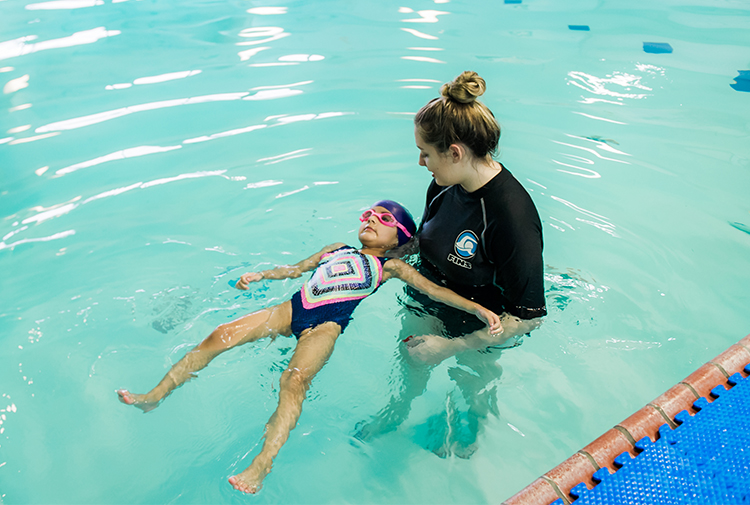
Back float and Roll to Back Float is incorporated throughout our classes with a range of methods including: singing a song, counting or practicing ABC’s while in back float position along with rolling to float from belly to back. We have 2 goals when teaching the back float; First is for your child to be comfortable in the back float position. We want them to sustain the back float so that they can get air and rest if they ever get in trouble in the water. The second goal is to create muscle memory. If this is achieved, your child will know to flip over on their back when they need air. The back float can be used for self-rescue, but can also be used to progress their swim endurance as they learn to swim further and further. We never rush a young child out of a back float position. We encourage them to take a rest, take a few breaths and relax.
Speaking of swimming longer distances, be on the lookout for an email next week where we dive deeper into breath control progression and increasing swim endurance within this program. You’ll find out just how far your child will be able to swim safely!
Read MoreBreath Control & Skill Progression
We are thrilled that you have chosen FINS as your swim school! FINS is a locally owned, family-run business with a big passion for teaching water safety and developing a love for swimming. By giving the gift of swim lessons to your child, you have taken an amazing step forward in the fight against the drowning statistics. Did you know that drowning is the leading cause of accidental death in children ages 1-4, and the 2nd leading cause in children ages 5-14? Drowning is preventable.
FINS has been around for over 20 years. Throughout that time, we have taught thousands of children (and adults) to learn to swim. Our goals remain the same while our methods vary over time since we are constantly finding ways to advance our techniques while providing a safe and fun environment for you and your child.
Read on and learn a bit more about what you and your child have to look forward to while swimming with FINS!
SAFETY-INDIVIDUALIZED ATTENTION-FUN!
These are the foundational elements of our unique Intro to Swim and Safety program. This program includes levels: Baby FINS 3, Red FINS, Aqua FINS and Yellow FINS. We are excited to tell you more about each of those words as they apply to our Intro to Swim and Safety program.
So let’s talk a little more about those words and how we use them in our Baby FINS 3, Red FINS, Aqua FINS, and Yellow FINS classes!
So let’s talk a little more about those words and how we use them in our Baby FINS 3, Red FINS, Aqua FINS, and Yellow FINS classes!
- SAFETY – We mentioned at the beginning of this email that drowning is the LEADING cause of accidental death in children ages 1-4, and the second leading cause in children ages 5-14. FINS is on a mission to reduce and even eliminate that statistic! Throughout their lessons, we will practice many safety skills and continue to build on them week after week. Skills include: breath control, back floating, various self-rescue techniques, and learning and memorizing safety rules!
- INDIVIDUALIZED ATTENTION – We are excited to offer a unique approach to swim lessons where ALL students enrolled in levels in our Intro to Swim and Safety levels will be in Private Lessons! Private lessons offer individualized attention and personalized instruction, which results in rapid water safety skill progression. After reading the section on the importance of water safety skills, I think you will agree, helping kiddos to master these skills faster is of utmost importance!
- FUN – Did you know that FINS in an acronym for Fun IN Swimming? Our passion is for swimming AND for kids. We want all kiddos to leave each lesson talking about how much fun they have had! We find creative ways to incorporate fun into all of our swim levels and in our facility. We know kids learn best when they are having fun and we hope they want to come back week after week. So, expect some fun to happen each time you come to FINS!
Be on the lookout next week for an email where we dive deeper into the FINS water safety techniques students will be learning in our Intro to Swim and Safety Program!
Read More